
Universal Basic Jobs (For The Young)
If there aren't enough local jobs, we can just create them

There are not enough good jobs that pay enough to live on, especially in post-industrial areas. That is the basic political fact that explains Brexit, Farage and the anger we see on our streets.
But I have good news for you. We can create jobs for all. But to do this, we need the government to step in where the private sector will not. This is possibly the most exciting thing the government is doing, that you’ve never heard about. Enter Universal Basic Jobs (For the Young) aka The Youth Guarantee.
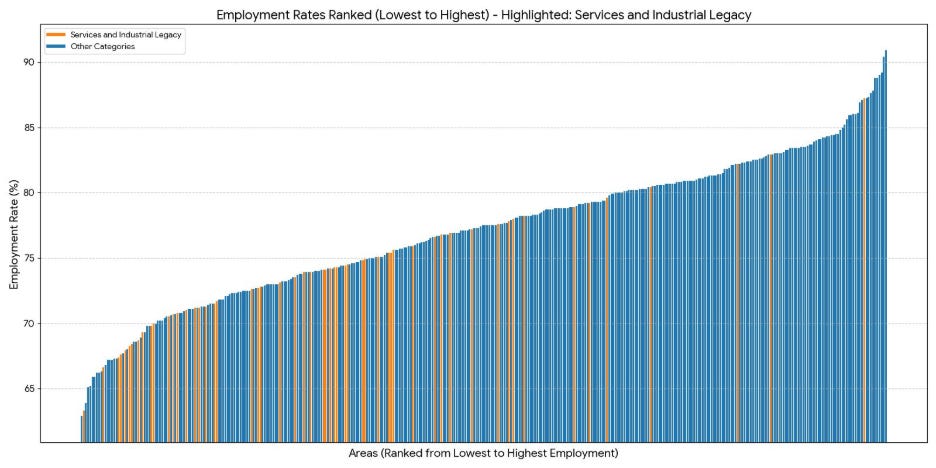
The national employment rate is at historic highs, but it masks a huge variation by area. Below I have ranked the employment rate in every part of the country. Notably, former industrial areas (coloured in orange) have a lower employment rate than the national average. These former industrial areas are the most deprived parts of the country with the highest numbers on disability related social security payments and the lowest life expectancy. The scars of a half-century ago have not healed.
Employment rates of Local Authorities, ranked lowest to highest. Orange bars are ex-industrial places.
Source: ONS
We need to help create a lot of jobs for the people that are struggling to find work (in the places with few jobs). But we should not expect the private sector to step in and create all the jobs that are needed in the places that need them. The labour market story of the last 50 years is that economic growth does not guarantee good work for all.
There are three reasons for this.
Firstly, because the era of mass-production manufacturing – of a single factory employing thousands of local non-graduates – has ended. This era is not coming back. We should not expect large factories that employ lots of people to open in postindustrial areas. New advanced manufacturing is more about robots that high-pay graduates end up operating.
Secondly, for deprived areas, fixing fundamentals like transport and liveable areas (the undelivered idea behind levelling up) is necessary but not sufficient for the private sector to create jobs. It may lead to more local jobs but not enough local jobs. Partly, that is because these areas are also demand deficient – there is not enough local spending to make it worthwhile for a business to move in and start operating in what are already deprived areas.
Thirdly, we should not expect the private sector to create jobs for the people who struggle the most to find one. After years of not having a job, many people leave the labour market altogether and move onto sickness and disability payments. Jobs need to be created with these people in mind – how do we create jobs for the people who find it hardest to get work?
Step in the Youth (Jobs) Guarantee, or what I like to call Universal Basic Jobs (For The Young). For young people who have been on Universal Credit for over 18 months, the government will directly fund six months of work1. These are jobs that the government is helping to create through 100% subsidies, in every part of the country, for long-term unemployed young people employers may not take a chance on. This is Hyman Minsky’s idea that the government should act as the employer of last resort in practice. Providing work for people that takes them as they are in the places that they are, not as we wish them to be.
We know that Universal Basic Jobs programmes like these can be successful, because we’ve seen them work elsewhere. One of the most exciting job programmes of recent times was the Marienthal scheme in Austria, where every long-term unemployed person was, first, offered an 8-week training course and then a paid job that guaranteed at least the minimum wage. This job could be (subsidised) private sector work or work with a nonprofit that led to community benefits (like cleaning the park). By limiting the number of funded hours, the net cost of this scheme to the taxpayer was zero i.e., it cost the same as social security payments.
The benefits were large and positive. People’s economic security improved as they moved into employment and they saw a large increase in their own well-being. Having a good job makes people healthier and happier. It leads to a virtuous circle.
But, and perhaps more importantly, directly creating more jobs also helps places improve. As I found in my PhD, stronger local labour markets means higher well-being. What did not happen when jobs were created was any increase in unemployment in the areas the program was levied or the surrounding areas. In a country without enough good jobs, these socially useful work placements would help to boost local well-being as people have productive things to do.
Universal Basic Jobs. An idea whose time has come.